 Budowle.pl


Central Park Tower in New York City (USA) - the tallest residential skyscraper in the world
Central Park Tower (skyscraper) is located in New York (United States). Its height is 472.4 m.
Where is Central Park Tower?
Address of Central Park Tower is 217 W 57th St, Midtown Manhattan, New York, USA
show on map
When did construction finish on Central Park Tower?
The construction date of Central Park Tower is 2014–2021 (construction), opening: 2021

Facts, information and history of Central Park Tower
Central Park Tower is a skyscraper that literally pierces the New York sky and has held the title of the tallest residential building in the world for several years. This stunning structure rises to 472.4 meters, and its slender, sleek silhouette has become a symbol of a new era in architecture – an era where the words “luxury,” “height,” and “exclusivity” have taken on entirely new meanings. But Central Park Tower is not just about numbers and records. It is the story of an extraordinary project, monumental engineering challenges, social controversies, and a future that some love and others decidedly less so.
Construction history and project origins – how was the Billionaires' Row giant born?
To understand what Central Park Tower is, one must go back to the early 2010s. Manhattan has always been a place where developers’ ambitions broke all records. But around 2012–2014, something changed – along 57th Street in New York, a phenomenon began to take shape that the press quickly dubbed “Billionaires' Row”. Along this single street, just steps from Central Park, some of the tallest and most expensive residential towers in the world began to rise. Central Park Tower was to be their crown jewel.
The project developer, Extell Development Company, led by Gary Barnett, announced construction plans as early as 2014. The location choice was deliberate – the plot at 217 West 57th Street borders directly on the legendary Nordstrom retail center, which eventually occupied the lower floors of the building. It was a clever move: retail at the bottom, luxury apartments above, all designed to generate revenue on multiple levels – literally and figuratively. The architectural design was entrusted to the renowned Chicago-based firm Adrian Smith + Gordon Gill Architecture (AS+GG), whose founder Adrian Smith also designed the world’s tallest building – the Burj Khalifa in Dubai.
Construction officially began in 2014 and lasted until 2021 – nearly seven years of intensive work. During this time, New York watched as an increasingly tall and slender silhouette rose from the construction site on 57th Street. The COVID-19 pandemic in 2020 slowed the pace somewhat and complicated apartment sales, but construction was completed. The official opening took place in 2021 and marked a historic moment – the world gained a new record holder.
Architecture and design – why does this building look the way it does?
When you look at Central Park Tower, one thing immediately strikes you: its slenderness is absolutely extreme. The building has a slenderness ratio of about 1:24, meaning that for every meter of width, there are 24 meters of height. For comparison, the average human figure has proportions of roughly 1:8. Central Park Tower is therefore three times slimmer than a human... Sounds abstract? That’s exactly the point.
The design by Adrian Smith and Gordon Gill is an example of what architects call a “supertall slender tower” – an ultra-tall and ultra-slim tower. The building’s facade is almost entirely made of glass and steel – the curtain wall panels reflect the sky, clouds, and Manhattan’s skyline, making the building look completely different at various times of the day. In the morning, when the sun rises over the East River, the tower shimmers with gold and pink hues. In the evening, it takes on a steel-like, almost navy glow. This is no accident – the architects deliberately designed the facade to respond to changing light.
The building’s footprint is surprisingly small – just about 2,800 square meters at ground level. For a skyscraper nearly 500 meters tall, that is very little. This small footprint results from site constraints and the project philosophy: the smaller the base, the more dramatic the impression of height. The lower floors are somewhat wider – housing the aforementioned Nordstrom store and some common areas. Above a certain level, the building tapers gradually, reaching peak slenderness at the upper sections. The architects also incorporated subtle setbacks and recesses on various floors, so the silhouette is not monotonous or dull but dynamic.
Technical data and records – breathtaking numbers
Central Park Tower is a treasure trove of impressive technical data. The building’s height to the top of the spire/antenna is 472.4 meters (1,550 feet). The height to the roof – excluding the spire – is 435.3 meters (1,428 feet). Thanks to this, Central Park Tower holds the positions of:
- The tallest residential building in the world (by architectural height).
- The second tallest building in the USA (after One World Trade Center, which measures 541 m).
- The third tallest building in the Western Hemisphere.
- One of the ten tallest buildings in the world.
The building has 131 above-ground floors and several underground levels. The usable floor area is an impressive approximately 93,000 square meters, a significant portion of which is occupied by luxury apartments – totaling about 179. There are both smaller units (though “small” is relative – studios are rare here) and massive penthouses spanning multiple floors.
The spire/antenna crowning the top is about 37 meters tall and is an integral part of the building’s architectural profile. For the Council on Tall Buildings and Urban Habitat (CTBUH), which sets official height rankings, the spire counts towards architectural height – hence the impressive 472.4 m.
To enable such a building to stand, advanced structural engineering was required. The tower’s load-bearing core is made of high-strength concrete with compressive strength reaching up to 130 MPa – concrete several times stronger than standard mixes. Additionally, due to extreme slenderness, engineers from WSP installed a special mass damper at the top. This several-hundred-ton water or mechanical mass tank dampens wind-induced vibrations. Without it, residents on the highest floors would feel the building sway like being on a ship in a storm.
Interiors and apartments – what is life like 1000 meters above ground?
Apartments in the building start roughly from the 40th floor – everything below is occupied by the Nordstrom retail center and common spaces. Even from this level, views of Central Park and Manhattan are absolutely spectacular. But the real paradise begins higher up – on the 80th, 90th, 100th floors and above. At such heights, you can literally watch sunsets above the clouds.
The interior design was created by the renowned Rottet Studio from Los Angeles. Residents can enjoy apartments finished in a style that could be described as “quiet luxury” – warm wood, marble, a subtle color palette, custom-made furniture. Floor-to-ceiling windows (or rather floor-to-ceiling!) flood interiors with natural light, and the views become the main decorative element of every space.
The building offers residents a list of amenities that could easily serve as advertising for a five-star hotel. Across several floors, you will find among others:
- Swimming pool with a view of Central Park (one of the most spectacular pools worldwide in terms of location),
- Fitness center and spa spanning multiple floors,
- Private residents’ club with meeting rooms, a library, and workspaces,
- Private cinema for residents,
- 24/7 concierge service,
- Wine cellar with proper conditions for storing collections,
- Game and entertainment rooms,
- Observation terraces accessible exclusively to residents.
Apartment prices start at several million dollars. Penthouses have been priced above 200 million dollars – yes, that is the price for a single residence. For comparison, such an amount could buy an entire Polish village with fields and forest. Despite this, demand – though slower than developers expected – exists. Ultra-wealthy buyers from around the world see such properties as a combination of investment, prestige, and lifestyle.
Engineering challenges – how to build a building taller than the clouds?
Building to such a height is not simply an “enlarged version” of a normal construction. It is a completely different challenge, requiring solutions to problems that simply do not exist at standard heights.
The first and arguably most important challenge was wind. At heights above 400 meters, wind speeds are significantly higher than at ground level and, worse, can be very variable and unpredictable. The building must withstand wind pressure without losing structural integrity or – equally important – without excessive swaying. WSP engineers had to perform hundreds of computer simulations and wind tunnel tests to optimize the building’s shape for minimal wind resistance. The specially shaped corners and facade recesses are therefore not just aesthetic devices – they are functional structural elements.
The second challenge was construction logistics in one of the most densely populated places on Earth. The construction site on 57th Street borders directly on sidewalks used daily by thousands of pedestrians and busy Manhattan traffic arteries. Material deliveries, crane operations, debris removal – everything had to be precisely planned to avoid paralyzing city traffic. The cranes used in Central Park Tower’s construction were among the tallest ever operated in New York.
The third problem was the foundations. Under Manhattan, the bedrock (gneiss and granitoids, commonly known as “Manhattan schist”) lies relatively close to the surface – one reason why New York can have such tall buildings at all. But even on bedrock, supporting such a heavy and tall building requires exceptionally solid foundations. Piles were driven deep into solid rock, and a massive foundation slab distributed the loads over as large an area as possible.
Finally, there was the issue of disturbances to nearby buildings and underground infrastructure. Beneath central Manhattan run subways, sewers, water mains, power cables, and dozens of other installations. Any major earthworks are a complex puzzle where one mistake can have serious consequences for the entire city.
Controversies and criticism – not everyone is enthusiastic
It would not be fair to write about Central Park Tower without mentioning the controversies, as there are quite a few. The admired Billionaires' Row towers – with Central Park Tower as their flagship – sparked a genuine social, architectural, and urban debate in New York.
The first and perhaps most fundamental controversy concerns shadows. Yes – shadows. Central Park Tower and other supertall slender towers on 57th Street cast long, narrow shadows over Central Park – one of the few green oases in the heart of Manhattan. Neighborhood residents, urban activists, and engaged organizations have warned that these buildings literally deprive the park of sunlight for a significant part of the day, especially in winter. Special analyses and maps have even been created showing how the shadow of Central Park Tower and neighboring towers moves across the park during the day. For many New Yorkers, this was and remains an unacceptable cost of private developers’ ambition.
The second criticism concerns gentrification and social inequality. A building intended exclusively for the ultra-rich, standing in a city where homelessness and housing affordability are pressing issues, is for many a symbol of a deeply unjust system. Critics ask: does New York need more luxury apartments, or rather affordable housing for ordinary people? This question has no easy answer but sounds particularly sharp in the context of Central Park Tower.
The third issue is aesthetic urban context. Some architects and critics believe that Billionaires' Row introduces chaos into Manhattan’s skyline – the buildings do not dialogue with each other or form a coherent whole but compete for the title of tallest. Each tries to be taller, slimmer, and more spectacular than its neighbor. The effect? New York’s panorama has gained several record-breaking silhouettes, but has it become more beautiful? Opinions are divided.
Despite all these reservations, it is hard to deny Central Park Tower one thing: it impresses. And hugely so.
Central Park Tower compared to other skyscrapers worldwide – where does the giant rank?
To fully appreciate the scale of this building, it is worth comparing it with other architectural giants.
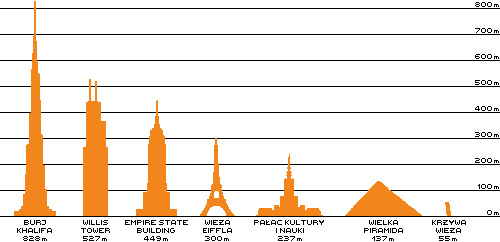
Burj Khalifa in Dubai (828 m) remains the absolute height record holder – Central Park Tower is over 350 meters shorter. However, Burj Khalifa is a mixed-use building (offices, hotel, apartments), not purely residential.
In the category of exclusively residential buildings, Central Park Tower beats them all – no other residential skyscraper in the world matches its architectural height. The previous record holder, 432 Park Avenue (also in New York, 425 m architectural), is nearly 50 meters shorter.
In New York, Central Park Tower ranks second in height – the leader remains One World Trade Center (541 m), a symbol of rebuilding after the September 11, 2001 attacks. Third place goes to 30 Hudson Yards (387 m).
Globally, considering all buildings regardless of function, Central Park Tower is among the top ten tallest buildings in the world. This is truly elite company – buildings numbering only a few dozen worldwide, each an engineering masterpiece.
Interesting facts you need to know
Every great building has its share of fascinating stories and facts rarely found in official press materials. Central Park Tower is no exception.
First – the mass damper. The aforementioned device at the top weighs hundreds of tons and moves slowly in the opposite direction of the building’s sway to neutralize it. Residents on the top floors may notice very subtle, almost imperceptible building movements during strong storms – but thanks to the damper, these remain within fully safe limits.
Second – the view from the highest floors. On clear days, from the penthouses atop Central Park Tower, one can see the New Jersey coastline, Connecticut, and even – according to some residents – the outline of Long Island over 60 kilometers away. It’s like having your own astronomical observatory, but in the center of Manhattan.
Third – the spire as a legal element. The 37-meter spire is not a meaningless ornament. Its main role is to qualify the building for a higher category in CTBUH rankings, which translates into the record title. Without the spire, the building would measure “only” 435 meters to the roof and would not top the rankings.
Fourth – logistics for residents. Such a tall building requires advanced delivery logistics. Distribution of packages, groceries, or furniture to floors 100+ is a serious undertaking. The building has an extensive elevator system – some are so-called express elevators that bypass lower floors to quickly transport residents upward.
Fifth – property value versus market realities. Developer Extell initially expected rapid sales of apartments at astronomical prices. Reality proved more complicated – many units remained unoccupied for a long time, and some prices were reduced. This phenomenon affected most of New York’s supertall slender towers – demand for luxury apartments costing tens of millions of dollars is simply limited, even globally.
Sixth – Nordstrom as a project partner. The Nordstrom retail center on 57th Street, occupying the lower floors of Central Park Tower, was the first store of this prestigious chain in New York. Its opening (in 2019, before the tower’s full completion) was a major retail event – New York had long awaited this brand.
Central Park Tower as a symbol of an era – what it tells us about the 21st century
Buildings have always been more than just buildings. Pyramids told stories of pharaohs’ power, Gothic cathedrals about the church’s ambitions, 1920s skyscrapers about faith in unlimited capitalist progress. Central Park Tower tells us something too – and that story is ambiguous.
On one hand, it is a symbol of technological triumph – proof that human engineering ingenuity can overcome gravity, wind, and all physical limitations, building higher, slimmer, and more impressively than ever before. It is also a symbol of the globalization of the luxury real estate market – a building selling apartments to clients from Russia, China, the Middle East, Europe, and both Americas, literally an address for the global elite.
On the other hand, Central Park Tower is a troubling image of inequality – a building existing detached from the everyday problems of the city it stands in. While thousands sleep on New York’s streets or pay half their salary for a studio rental, a $200 million penthouse symbolizes a chasm that is growing deeper in the 21st century.
Perhaps that is why Central Park Tower polarizes opinions so strongly. It is not just a building – it is a mirror reflecting the soul of our times. And not everyone likes what they see in that mirror.
Summary – a record that will stay with us for a long time
Central Park Tower is undoubtedly one of the greatest architectural and engineering achievements of the 21st century. Record height of 472.4 meters, extremely slender silhouette, refined interiors, breathtaking views – all these factors ensure that this building will remain at the top of rankings and in the consciousness of architecture enthusiasts worldwide for a long time.
Is Central Park Tower a beautiful building? That is a question everyone must answer for themselves. Is it an important, significant, groundbreaking building? Absolutely yes. It changed New York’s skyline, frightened some, amazed others, sparked important discussions about the city, luxury, and for whom we really build. And that fact alone makes it more than just a record – it is a conversation worth having.
New York had Empire State Building as a symbol of one era, One World Trade Center as a symbol of another. Perhaps Central Park Tower will be the symbol of ours – an era of extremes, technological genius, and questions we are still searching answers for. One thing is certain: next time you find yourself in Manhattan, look up to the sky on 57th Street. That view will stay with you for a long time.
Architect of Central Park Tower
How tall is Central Park Tower?
Height of Central Park Tower is 472.4 m (with spire/antenna), 435.3 m to roof

Construction/building type
Building Central Park Tower is of type Skyscraper
Architectural style
Architectural style of Central Park Tower is Modern
Modern architectural style is a style characterised primarily by simple and regular forms, a lack of ornamentation and the use of modern building materials. It is significantly different from other architectural styles, such as Baroque, Gothic or Renaissance, where more complex forms and rich ornamentation predominated. ... read more.
Other dimensions, parameters and frequently asked questions

What is the area of Central Park Tower?
Central Park Tower covers an area of approx. 93,000 m² (total usable floor area)
What material is the building made of?
Central Park Tower is made of the following materials: Steel, high-strength concrete, glass
Cost
Build cost of Central Park Tower is approx. 3 billion dollars (estimated)
Practical information

How much is admission to Central Park Tower?
Tickets for Central Park Tower are available at the following prices and variants:
None (private building)
Other names
The building is also known by other common names or in the original language, i.e. Nordstrom Tower
Official website
The official website of the building, where up-to-date information can be found, is https://www.centralparktower.com
Questions and answers
What is Central Park Tower?
Central Park Tower is a luxury residential skyscraper located near Central Park in New York City, recognized as the tallest residential building in the world.
When was Central Park Tower completed?
Construction began in 2014 and was completed in 2020.
Who was the architect of Central Park Tower?
The skyscraper was designed by the firm Adrian Smith + Gordon Gill Architecture.
How tall is Central Park Tower?
The building is 472 meters tall, making it one of the tallest residential buildings in the world.
Is it possible to enter and tour Central Park Tower?
No, Central Park Tower is a private building accessible only to residents.


Photo gallery


Location on map / How to get there
Find accommodation nearby
Weather nearby

Rent a car nearby

Author

Author: Redakcja Budowle.pl
Pasjonat architektury, właściciel portalu Budowle.pl
Date added: 19/07/2026 Last updated: 19/07/2026 Number of views : 1226


Comments to Central Park Tower (0)
Be the first to add a review!
No comments